
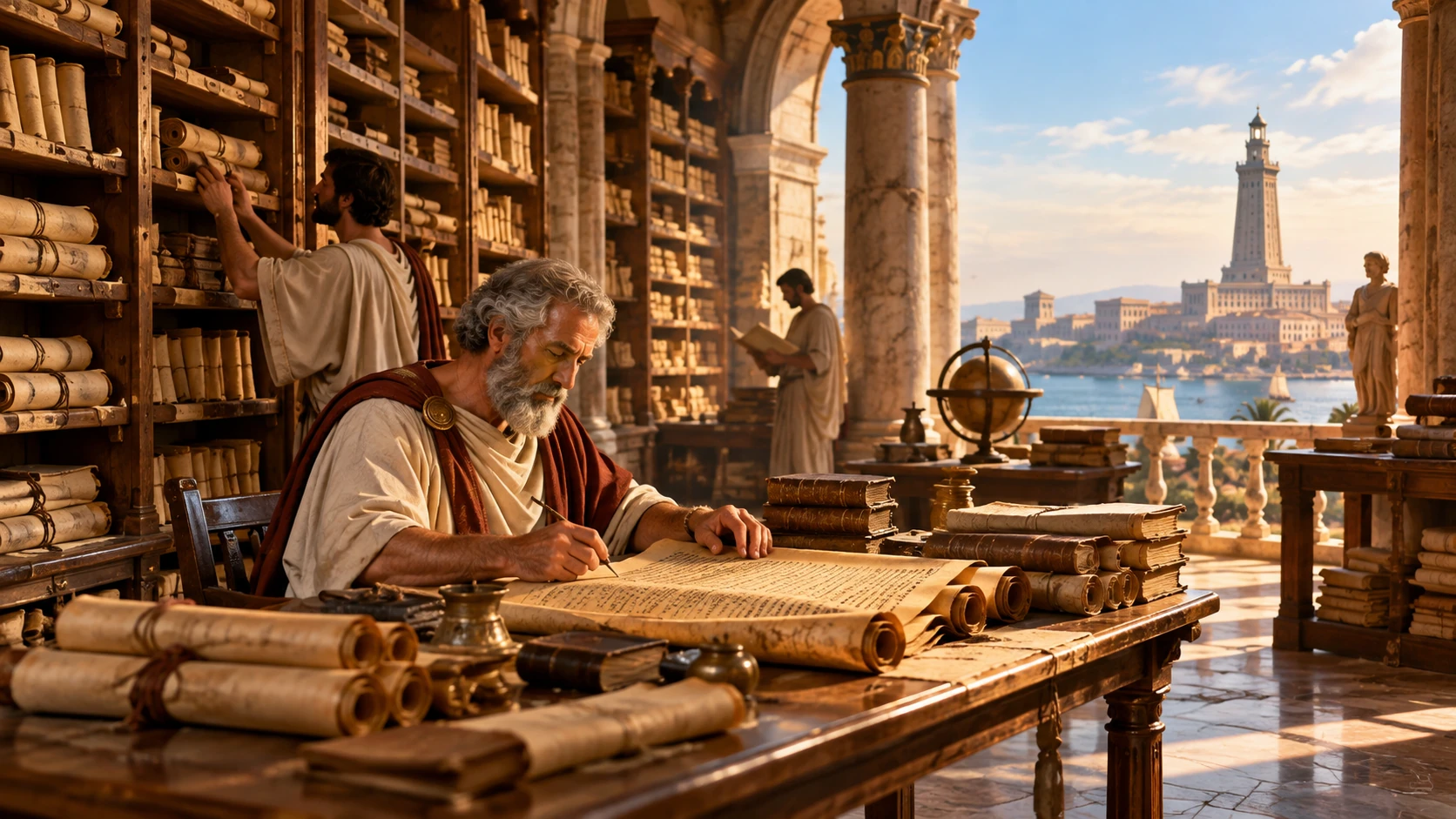
Long before computers, cloud storage, and digital archives existed, people relied on manuscripts and libraries to preserve knowledge. Ancient libraries served as important centers for collecting, organizing, copying, and sharing information. They protected written works from being forgotten and helped ideas travel across generations and regions.
Libraries Created Places for Knowledge
Ancient libraries were more than rooms filled with books. They could function as centers of scholarship where writers, teachers, researchers, translators, and students gathered.
Collections could include works covering subjects such as mathematics, medicine, astronomy, philosophy, literature, history, law, religion, and agriculture. Bringing these materials together made it easier for scholars to compare ideas and build upon earlier work.
A library therefore became a place where existing knowledge could support the creation of new knowledge.
Written Records Protected Information
Before widespread printing, information was often passed from person to person through oral traditions. While oral storytelling was extremely valuable, written records provided another way to preserve information.
Scribes could record stories, observations, laws, scientific ideas, and administrative information on materials such as clay tablets, papyrus, parchment, or other writing surfaces.
These records gave future generations access to ideas that might otherwise have disappeared.
Copying Manuscripts Was Essential
Ancient texts could deteriorate because of moisture, insects, fire, handling, or the natural aging of writing materials. One way libraries and scholars preserved information was by creating copies.
Scribes carefully reproduced manuscripts so that their contents could continue to exist even when an older copy became damaged.
The copying process was labor-intensive and could introduce mistakes, but it was essential to maintaining written traditions.
The Library of Alexandria Became a Symbol of Scholarship
The ancient Library of Alexandria is one of history’s most famous examples of a knowledge center. Located in ancient Egypt, it became associated with scholarship and the collection of texts from different parts of the known world.
Scholars connected with Alexandria studied subjects including mathematics, astronomy, medicine, philosophy, and literature.
Although popular accounts sometimes describe the library as being destroyed in one dramatic event, historians generally regard its history and eventual decline as more complicated. The example remains important because it represents the ambition to gather and preserve knowledge on a large scale.
Translation Helped Ideas Cross Languages
Ancient centers of learning also contributed to the movement of knowledge between languages and cultures. Translators could convert texts from one language into another, allowing ideas to reach new communities.
Translation helped preserve important works even when the original language later became less widely used.
It also allowed scholars to compare different intellectual traditions and build upon ideas developed elsewhere.
Libraries Preserved Cultural Heritage
Ancient libraries did not only contain scientific or philosophical works. They could also preserve stories, poems, religious texts, historical accounts, legal documents, and records of everyday life.
These materials provide modern historians with evidence about how earlier societies understood their world.
Written records can reveal information about social structures, trade, political systems, education, family life, technology, and cultural beliefs.
Knowledge Was Passed Between Civilizations
Knowledge did not remain permanently within the civilization where it was first recorded. Ideas could travel through trade, migration, translation, education, conquest, and scholarly exchange.
Mathematical concepts, astronomical observations, medical knowledge, literary works, and philosophical ideas were developed and transmitted across different regions over long periods.
Libraries helped support this process by providing scholars with access to collections of existing works.
Ancient Libraries Also Had Limitations
It is important to remember that access to ancient knowledge was not equally available to everyone. Literacy was limited in many societies, and producing manuscripts required considerable resources.
Some collections were associated with rulers, religious institutions, or elite scholarly communities.
Additionally, many texts have been lost. Fires, wars, political changes, natural deterioration, and the disappearance of copying traditions contributed to the loss of countless works.
The surviving records therefore represent only part of the knowledge that ancient societies once possessed.
Archaeology Continues to Recover Lost Information
Modern archaeologists and historians continue to discover ancient written materials. Excavations can uncover tablets, fragments, inscriptions, manuscripts, and other records that provide new information about earlier civilizations.
Even a small fragment can be valuable when researchers compare it with other surviving evidence.
Modern conservation techniques also help protect fragile materials from further deterioration.
The Connection Between Ancient and Modern Libraries
Modern libraries continue the basic mission of ancient collections: preserving information so that it remains available for future generations.
The materials have changed dramatically. Instead of relying primarily on handwritten manuscripts, today’s libraries can preserve printed books, photographs, recordings, films, databases, and digital documents.
Digital technology has made it possible to create multiple copies and provide access to information across great distances.
Why Ancient Libraries Still Matter
Ancient libraries remind us that preserving knowledge has always required effort. Every manuscript that survived represents someone’s decision to record, copy, store, protect, or pass on information.
Their legacy can still be seen in modern education, research, museums, archives, and libraries.
Ultimately, ancient libraries helped preserve knowledge by bringing written works together, supporting scholars, encouraging copying and translation, and creating systems through which information could move between generations. Even though countless texts have disappeared, the materials that survived provide an invaluable connection to the past. They show that the desire to learn from earlier generations and leave knowledge for those who come after us is not a modern idea—it has existed for thousands of years.