
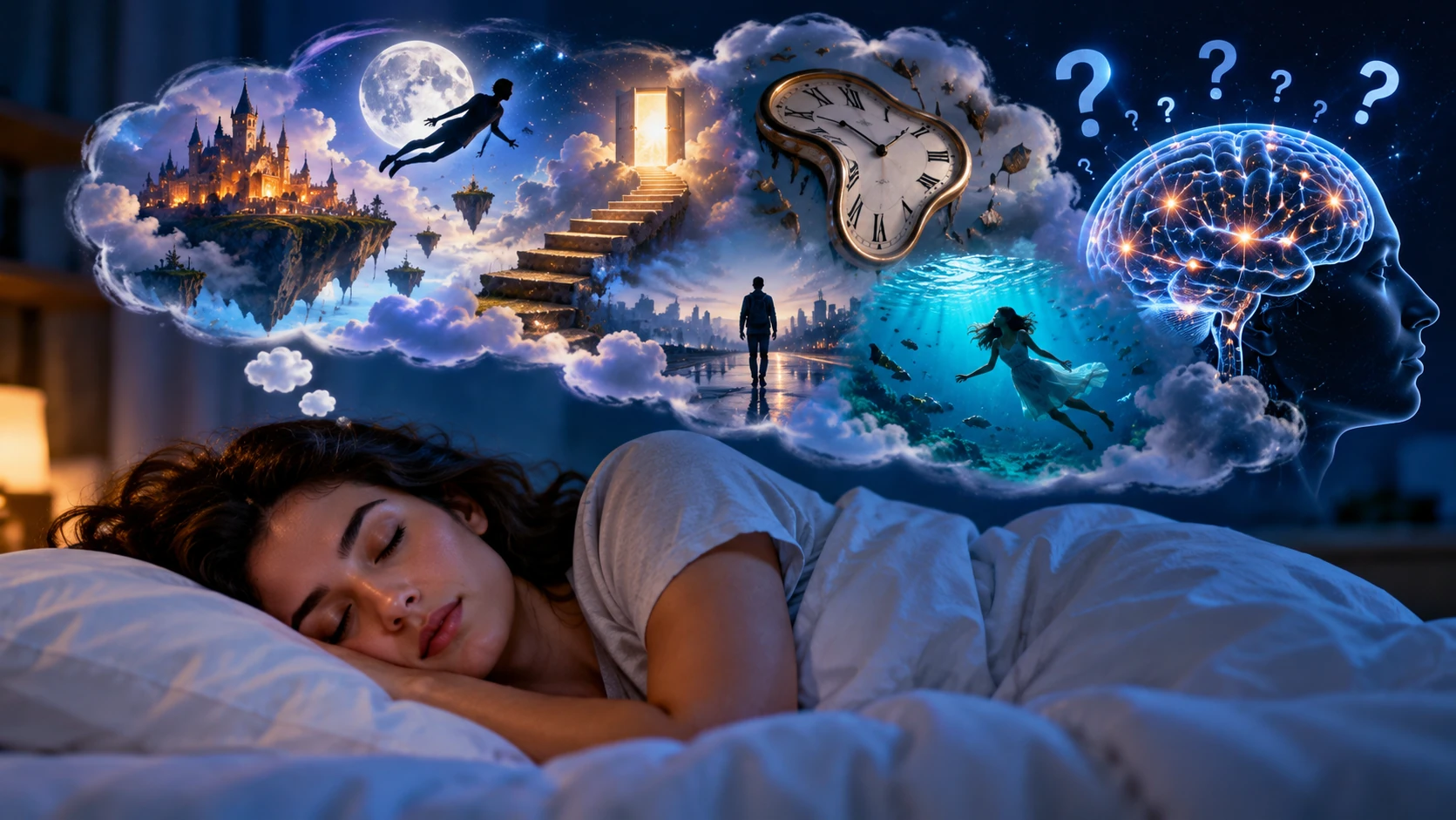
Dreams are one of the most fascinating experiences of the human mind. Almost everyone dreams, yet scientists still do not have complete answers about why dreams happen, what they mean, or why some dreams feel remarkably realistic. During sleep, the brain remains active in surprising ways, creating stories, images, sounds, emotions, and sometimes entire imaginary worlds.
Although researchers have learned a great deal about sleep and dreaming, many strange facts about dreams remain unexplained. These mysteries continue to make dreams an important subject of scientific research.
Most People Dream Every Night
One interesting fact is that dreaming appears to be a normal part of sleep rather than something experienced only occasionally. People may have several dreams during one night, particularly during periods of rapid eye movement, commonly called REM sleep.
However, people do not remember most of their dreams. A person may wake up with a clear memory of a dream but forget nearly all of it within minutes. This happens because dream memories can be unusually fragile compared with memories formed while awake.
Dreams Can Feel Completely Real
Dreams can create experiences that seem almost indistinguishable from reality. People can see familiar locations, hear voices, recognize faces, and experience strong emotions while dreaming.
The brain can generate detailed sensory experiences without receiving the same information from the outside world. This raises interesting questions about how the brain constructs our perception of reality while we are awake and asleep.
Dreams Can Include Strange Combinations
Dreams often combine ordinary memories and experiences in unusual ways. A dream might place a childhood home in an unfamiliar city or bring together people who have never met in real life.
Scientists believe dreams can involve different types of memory and information processing. However, exactly why the brain creates certain combinations remains uncertain. The strange structure of dreams makes them difficult to study because every person’s dream experience can be different.
Some Dreams Are Extremely Emotional
Fear, excitement, sadness, embarrassment, and happiness can all become intense during dreams. Nightmares are particularly memorable because strong emotions may make the experience more noticeable after waking.
Researchers continue to investigate the relationship between dreaming and emotional processing. One possibility is that dreaming may be involved in how the brain handles emotional experiences, although there is still no single explanation that accounts for every type of dream.
People Can Experience Lucid Dreams
A lucid dream occurs when someone becomes aware that they are dreaming while the dream is still happening. Some people can even influence what happens next, such as changing their surroundings or deciding where to go.
Lucid dreaming is especially interesting to scientists because it creates an unusual state in which a person is asleep but has some awareness of the dream experience. Researchers have used sleep studies to investigate how awareness changes during these dreams.
Dreams Can Sometimes Inspire Creative Ideas
Throughout history, people have reported finding inspiration in dreams. Artists, writers, musicians, inventors, and scientists have sometimes described dreams that influenced their ideas.
While dreams should not automatically be considered a source of hidden solutions, the brain can make unusual connections during sleep. Reduced attention to everyday rules may allow memories and concepts to combine in unexpected ways.
Why Do We Dream About People We Know?
Familiar people frequently appear in dreams. Sometimes the person plays an obvious role, while at other times their appearance seems completely random.
Researchers still do not fully understand why particular individuals appear in specific dreams. Their presence could relate to memories, emotions, recent interactions, or associations connected with that person. In other cases, there may be no obvious explanation.
Dreams Can Change as We Age
Dream patterns are not necessarily identical throughout life. Sleep architecture changes with age, and the way people experience and remember dreams can change as well.
Children, teenagers, and adults may report different dream experiences. However, because dream research often relies on people describing their dreams after waking, scientists face challenges when comparing dream experiences across different age groups.
The Meaning of Dreams Remains Uncertain
One of the biggest mysteries is whether dreams have specific meanings. Many cultures have developed systems for interpreting dreams, but scientific research has not established a universal dictionary in which a particular dream always represents a specific event or emotion.
A dream about flying, falling, losing something, or meeting someone may mean different things to different people. Personal experiences and circumstances can influence dream content.
Scientists Still Have Many Questions
Modern sleep research has revealed important information about brain activity during dreaming, but many questions remain. Scientists continue to study whether dreams contribute to memory, learning, emotional regulation, creativity, or other mental processes.
The difficulty is that dreams cannot be observed directly in the same way as many physical processes. Researchers often need people to report what they remember after waking, which means some information may already be lost.
Why Dreams Continue to Fascinate Us
Dreams sit at the intersection of biology, psychology, memory, emotion, and imagination. They can be confusing, beautiful, frightening, or completely bizarre, sometimes all within the same night.
The more scientists learn about sleep, the more interesting dreaming becomes. Strange facts about dreams remind us that the brain is capable of creating complex experiences even when the body is resting. Until researchers fully understand why dreams happen and what purpose they serve, dreaming will remain one of the most intriguing mysteries of the human mind.